
Agent Crew
The Digital Health CS Agent Crew
A customer success operating model for digital health, run by a crew of AI agents.
Ask it about an account, a renewal, or tomorrow’s call, and a Chief of Staff sends the work to the directors it needs. Five directors each own one piece of the account. A critic agent, Sentinel, judges whether the work is sound before the CS leader sees it. The crew takes on the prep work that eats most of a CS leader’s week, so they can spend that time on judgment, relationships, and sequencing.
›Prep me for the Tresmont Health Plan QBR on October 7.
QBR deck
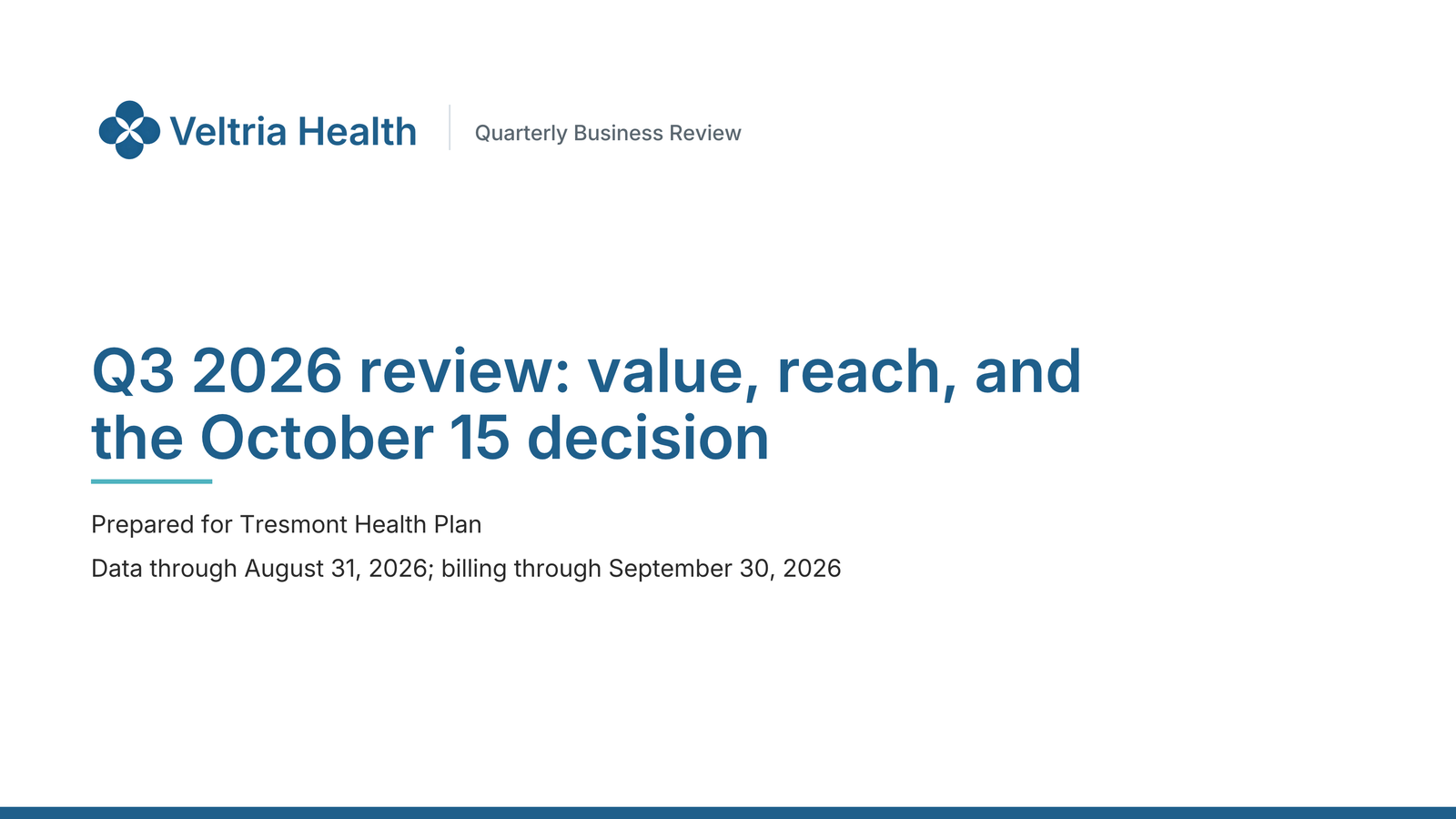
Built from the team’s own slide library
Champion brief
Veltria’s value to Tresmont this year rests on three things, each with its measure.
One paragraph for Rachel to carry into the October 15 room without Veltria present
Email, left as a draft
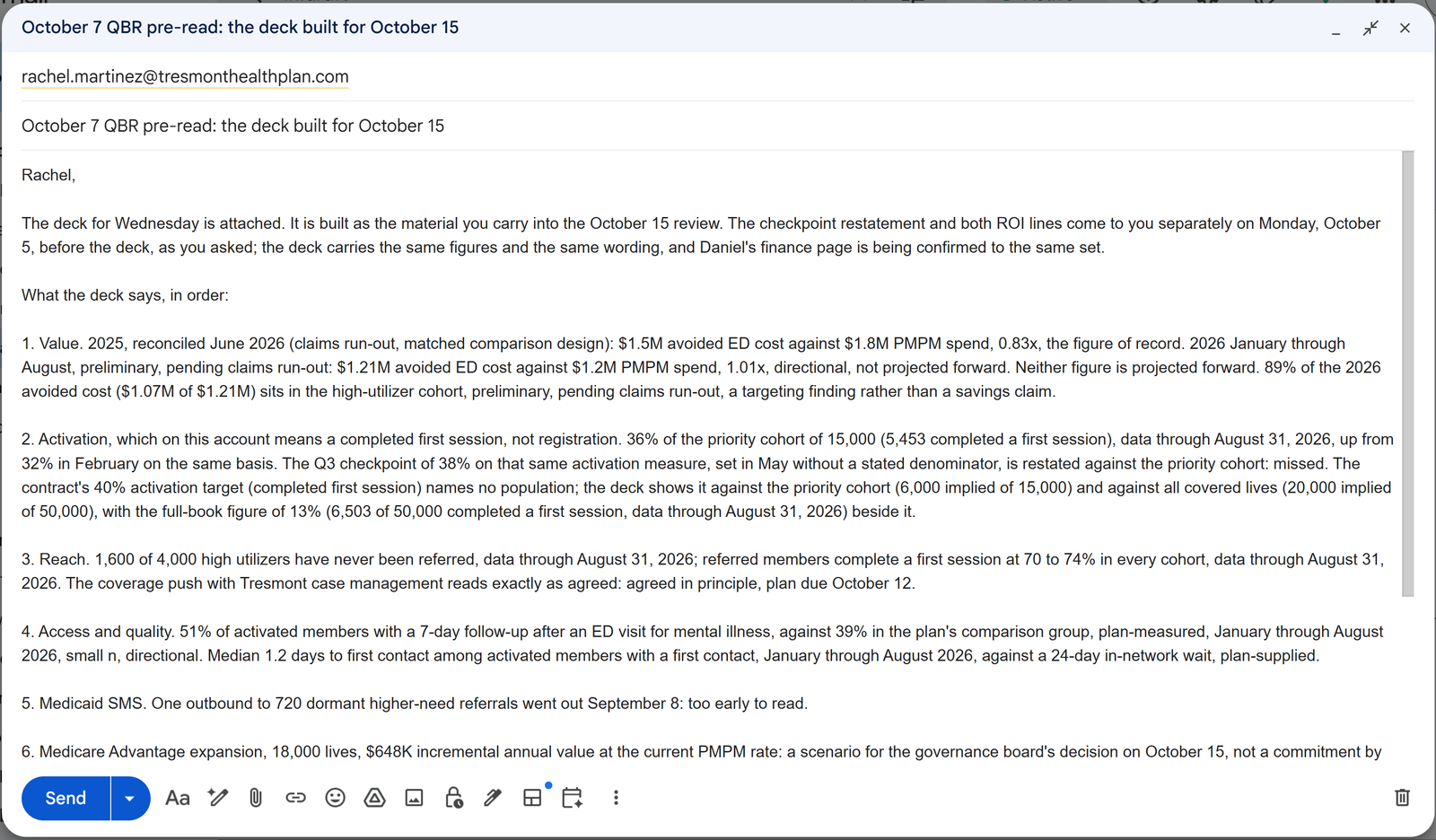
Nothing sends without a person
QBR prep package
Tresmont Health Plan: Quarterly Business Review package, QBR Wednesday October 7, 2026
Prep doc, deck spec, brief, email, and build record on one Notion page. Sentinel gate 2: PASS, no flags.
What came back from one request, in the demo below.
The problem
Three customers, one contract
Every digital health account has three customers: a payer measuring return, a provider measuring clinical and operational results, and a member who never asked for the product and only keeps using it if it helps. In this industry "customer" usually means the buyer. Here it means each of the three has to be won and kept as if they had bought. Each defines value differently, and the contract unravels at whichever one stops seeing it. The CS leader holding that contract is holding a book of others, and most of the week goes to prep.
A payer
measuring return
A provider
measuring clinical and operational results
A member
who never asked for the product and only keeps using it if it helps
One contract
Prep crowds out strategy. QBR decks, status emails, and renewal proposals take the time meant for relationships and coaching.
One of the three stories is always stale. Building the payer, provider, and member story by hand means one of them falls behind.
Signals arrive late. By the time the data shows a problem, the renewal conversation has started.
Every revenue model fails in its own place. PMPM, PEPM, CPT, value-based, and hybrid contracts behave differently, and the math sits unevenly across a team.
Activation stalls. It's a marketing problem living inside CS, and most CS teams aren't built to run campaigns.
Quality depends on who owns the account. The same depth of work doesn't reach every account in the book.
The crew is built for that account.
The operating model
What makes up the operating model
The framework. The Revenue Model Sets the Strategy, which the rest of the model turns into rules.
Shared Domain Model. The framework as constants every agent reads: stakeholder labels, revenue math, activation benchmarks, funnel stages, health score components. (See below.)
Guardrails. The rules no task can override. (See below.)
Architecture specification. The Chief of Staff, five directors, civilians, and Sentinel, and how a run moves through them. (See below.)
Chief of Staff and director prompts. The instructions each agent runs on. They carry no client names or figures, so the same prompts work on any account.
Sentinel specification. What the critic checks and the conditions that keep it independent. (See below.)
Wiring instructions. How the agents connect to the system of record, email, call recordings, and the deck tool.
Implementation methodology. The path from demo to pilot to production, and the governance a CS organization needs to land it.
Eval methodology. How the crew is tested against a fixed set of prompts.
Account schemas. What an account record has to carry before the crew can work on it, including a metric-definition template.
Playbooks. The plays Pulse recommends for an at-risk account, and the stakeholder value maps.
Original diagrams and explanatory material. The architecture diagram, the map of what each director reads and produces, and the videos.
Where this stands: v1.0 is the recorded loop and the build guide. The playbooks and the eval test set are the two parts still being built. The first test set lands at v1.1.
How it works
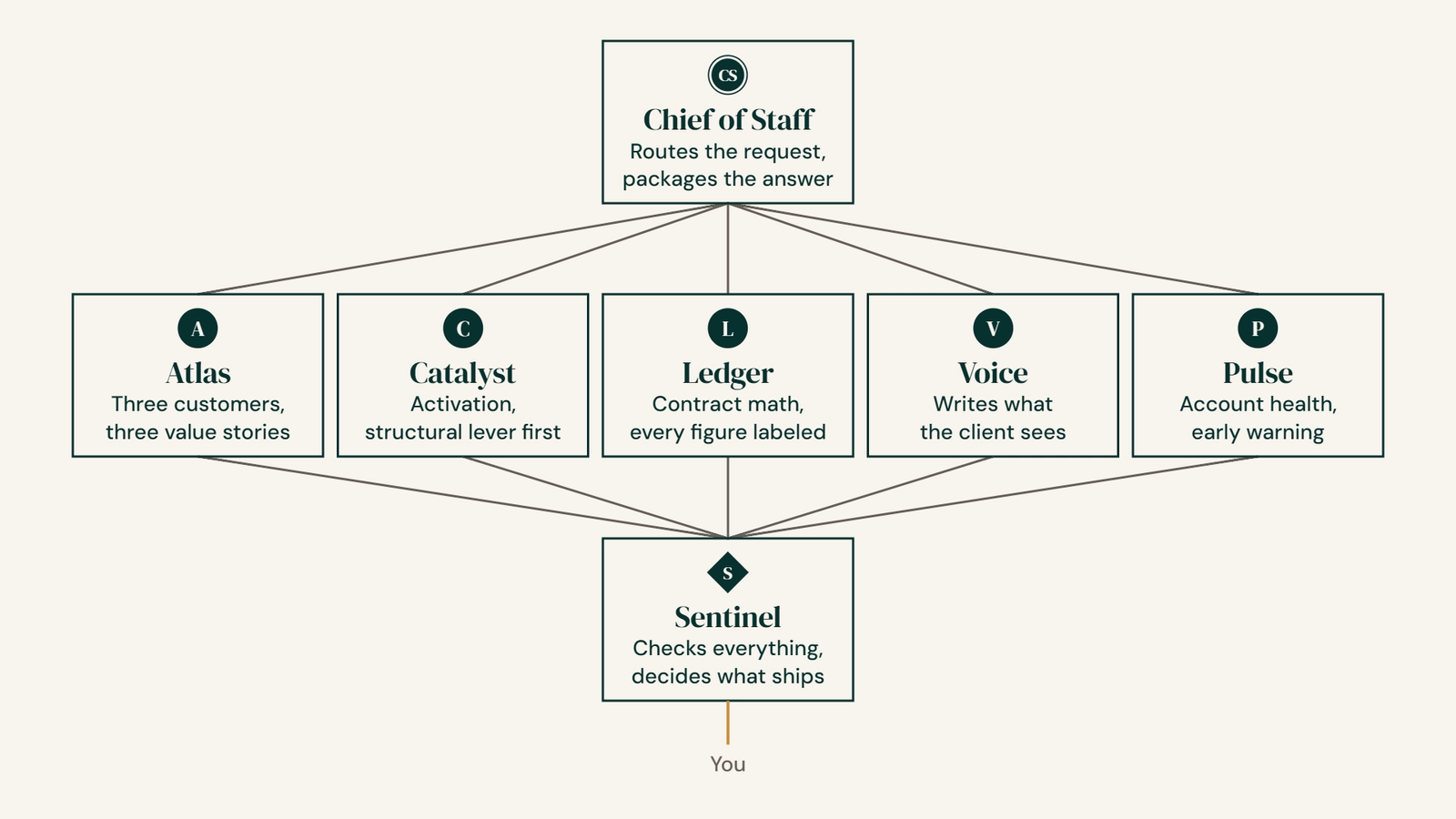
One orchestrator, five directors, one critic
A request goes to the Chief of Staff. Some questions it answers from the record itself. A question that needs judgment goes to one director. Something like QBR prep goes to all five, and Sentinel checks the package before the CS leader sees it.
›Prep me for the Tresmont Health Plan QBR on October 7.
Examples of what you can ask it
All six ran against one fictional account: Tresmont Health Plan, the invented client of Veltria Health, an invented digital behavioral health company.
What did Rachel at Tresmont ask for in her last email?Handled by the Chief of Staff directly
Read the account page and four email threads from Rachel, the last two in full. No call transcripts read.
Rachel's last email was September 22, 2026, subject "October QBR, moving to the 7th".
Move the QBR from October 1 to Wednesday, October 7, same time. Send the Q3 checkpoint restatement before the deck, not with it.
Handled by the Chief of Staff directly. No director spawned, no gate.
What's the stakeholder picture on Tresmont Health Plan?Atlas alone
Read the account record, three call transcripts in full, and six email threads.
Three stakeholders, three different states, one gating event with no evidence of an outcome.
The Patient/Member side is the weak leg: activation sits four points short of a target the contract never gave a denominator, and the drop is at reach, not conversion.
The Chief of Staff spawned Atlas alone. No gate, nothing written to the system of record.
What is the health score of Tresmont Health and what moved it?Handled by the Chief of Staff directly
Read the account page, two of three call transcripts, and three of six email threads.
Tresmont Health Plan: Yellow, 64 of 100. Improving slowly.
Reach is the primary drop stage. 1,600 high utilizers have never been referred.
Handled by the Chief of Staff directly, no directors spawned (single-source question).
Is Tresmont Health green, yellow, or red, and why?Pulse, sole director
Read the account record and its Financial Detail, three call transcripts, and six email threads, all in full.
Yellow. Composite 64 of 100, computed from the six component scores on the account record under the Shared Domain Model's six-factor model (Green 75+, Yellow 50 to 74, Red below 50).
Yellow 64 is the last reading on the gauge, not a current one. Refresh the sources before anyone acts on this color.
Routing: Pulse, sole director. Single-director output, no Sentinel gate.
Where does the Tresmont Health Plan renewal stand?Handled by the Chief of Staff directly
Read the account record and its Financial Detail, one of three call transcripts, and three of six email threads.
The renewal is unresolved, and the crew's sources don't record the gating event.
Tresmont is in year 2 of a 3-year, $1.8M PMPM term.
Handled directly by the Chief of Staff; no director spawned.
Prep me for the Tresmont Health Plan QBR on October 7.The whole crew, through Sentinel's gate
QBR deck
Built from the team's own slide library
Champion brief
Veltria's value to Tresmont this year rests on three things, each with its measure.
One paragraph for Rachel to carry into the October 15 room without Veltria present
Email, left as a draft
Nothing sends without a person
QBR prep package
Tresmont Health Plan: Quarterly Business Review package, QBR Wednesday October 7, 2026
Prep doc, deck spec, brief, email, and build record on one Notion page. Sentinel gate 2: PASS, no flags.
The whole crew, through Sentinel's gate. Shown in full in the demo below.
Built for any request across the account's life, from the sales handoff to renewal. The QBR and five simple questions are the runs shown so far.
Each answer is the crew's own text, cut, not rewritten. Every name and figure is fictional.
Built on the framework. Ledger carries the math for each revenue model. Atlas works from the three customers. Catalyst works the Engagement Gate, where a member actually starts using the program.
Chief of Staff
Orchestrator
Reads the request, sends the work to the directors it needs, and pulls the answers into one package. A simple question gets a simple answer, without a full fan-out.
Watch the Chief of Staff in actionAtlas
Stakeholder Director
Maps what the payer, the provider, and the member each count as value, and flags the one pulling the contract down. Built for payer, provider, and employer accounts. Pharma accounts sit outside v1.0.
Watch Atlas in actionCatalyst
Activation Director
Designs activation the way a marketer would, structural levers before channel and copy, and hands it off without touching member records.
Watch Catalyst in actionLedger
Revenue Director
Models PMPM, PEPM, CPT, value-based, and hybrid contracts, and lets no activation figure anchor a financial conclusion until it names what it is measured against.
Watch Ledger in actionVoice
Executive Comms Director
Writes what the client sees, from the QBR deck to the one-paragraph brief the champion, the person who takes our results to her own leadership, carries into a meeting the CS team is not in.
Watch Voice in actionPulse
Account Health Director
Watches leading indicators and flags risk with the signal, the stakeholder, the funnel stage, an owner, and what to do next.
Watch Pulse in actionCivilians handle one-off jobs like data assembly and dissolve when done. In production the data comes from a CRM or a warehouse instead of Notion, and the agents stay the same.
The critic
One step that sees everything
Sentinel produces nothing for the client and owns no account. It reads the whole package against every director's original output, because contradictions and dropped qualifiers are only visible from there.
What it checks
Denominators
Every activation figure names its denominator before it anchors a target, forecast, or risk call.
Consistency
The payer, provider, and member stories cannot contradict each other on the same fact.
Escalation
Clinical or vulnerable-population content, commitment language, a risk flag with no owner, or an output with no destination goes to a person, with the reason named.
What makes it work
Fresh context
A critic that inherits the crew's framing inherits its misreadings.
No silent fixes
It flags and returns, and does not edit a director's work.
A ceiling
The same flag twice goes to a person with both attempts attached.
The guardrails
Rules no task can override
Every agent works from one shared domain model, the framework turned into constants: stakeholder labels, revenue math, activation benchmarks, funnel stages, health score components, and these guardrails. Most of them end with a person owning something.
- 1Health scores. A health score is an indicator. The CS leader makes the call.
- 2Clinical content. Nothing clinical, and nothing aimed at a vulnerable population, goes out without a person approving it.
- 3Revenue language. Revenue language that could read as a commitment is checked by a person before a client or finance sees it. Forecasts are labeled base, upside, or downside.
- 4Expansion signals. An expansion signal is a lead for sales to qualify, not pipeline.
- 5Risk flags. A risk flag names who handles it and how, or it does not ship.
- 6Destination first. The crew confirms who an output is for, and what kind of data it carries, before it writes it.
- 7Recommended plays. A recommended play is an input to a decision a person makes.
- 8Data freshness. Every output says how current its data is. Stale data is labeled, never used quietly.
- 9Employer data. An employer never sees anything below the aggregate, and small groups are suppressed.
- 10Audience labels. Every output names its audience, and the audience decides what data it may carry and what review it needs.
Designed with HIPAA-aware controls: synthetic by default, minimum-necessary architecture, human approval gates, destination-based output controls, and vendor/BAA validation required before PHI use.
Not HIPAA-ready, which would take vendor-by-vendor BAA validation and a formal compliance review.
The demo
One request, the whole crew
The demo shows the biggest request the crew takes. The crew run is real. The account is not: Veltria Health is an invented digital behavioral health company and Tresmont Health Plan is its invented client. I gave the crew one request: "Prep me for the Tresmont Health Plan QBR on October 7."
What Sentinel caught
Voice's slide, before Sentinel
1.01x, preliminary, pending claims run-out
Ledger's qualifier on the same figure read "directional; not annualized." Voice dropped both on the way to the slide.
The slide, after Sentinel
1.01x, preliminary, pending claims run-out, directional, not annualized
On the slide the line sits beside last year's reconciled 0.83x, the figure of record.
Ledger attached two conditions that Voice dropped on the way to the slide. Sentinel caught it by reading Ledger's output instead of the slide. It also handed me seven decisions it would not make on its own. Those were mine to make.
Every company, person, and figure in the demo is fictional. No real client data appears anywhere in this build.
The boundary
What it's not
The crew
prepares
drafts
designs activation
recommends
builds toolkits
The human
decides
sends
owns relationships
judgment and negotiation
clinical and domain expertise
Not a replacement for CSMs.
The team owns relationships, judgment, sequencing, and negotiation.
Not automated decision-making.
Every recommendation is an input to a person's decision.
Not a substitute for clinical or domain expertise.
Not a client-facing tool.
It drafts, and a person sends.
Not a member communication platform.
It designs activation and builds toolkits, and execution runs through the compliant channels a client already uses.
Twice the accounts per CSM is also twice the judgment load, so the fair question for any tool like this is who else gets busier when it works.
A living system
The roadmap
Version 1.0 proves the engine runs. Everything after it is documented and sequenced, and none of it is built yet.
- v1.0, the demo
The recorded loop above, the build guide, and a second video on how the crew is built.
- v1.1, hardening
A fixed set of test prompts the crew has to pass, runs sized to the ask, from a quick answer to a full package, and a morning brief from Pulse on a schedule.
- v1.2, domain depth
Account-level practice turned into shared rules, so a new account works with no prompt edits.
- v1.5, a second company
The same crew run for a second fictional company on a different contract model, shown in a third video.
- v2.0, new work
Overnight testing of activation copy for a person to choose from, structured education for each stakeholder group, a boundary that keeps member-level data away from the agents, campaign visuals behind an approval gate, and renewal and reference preparation, each built only when something pulls it.
Build it yourself
The build guide is the crew in a form you can stand up on your own tools: the reasoning behind the design, the prompts and the Shared Domain Model as plain files tagged by crew version, runtime notes for each tool a run has verified, and the metric-definition template. It's free to subscribers, who get it first when it ships.
Your email delivers the build guide when it ships, plus occasional new insights from Digital Health Success. No spam. Unsubscribe anytime. Privacy policy